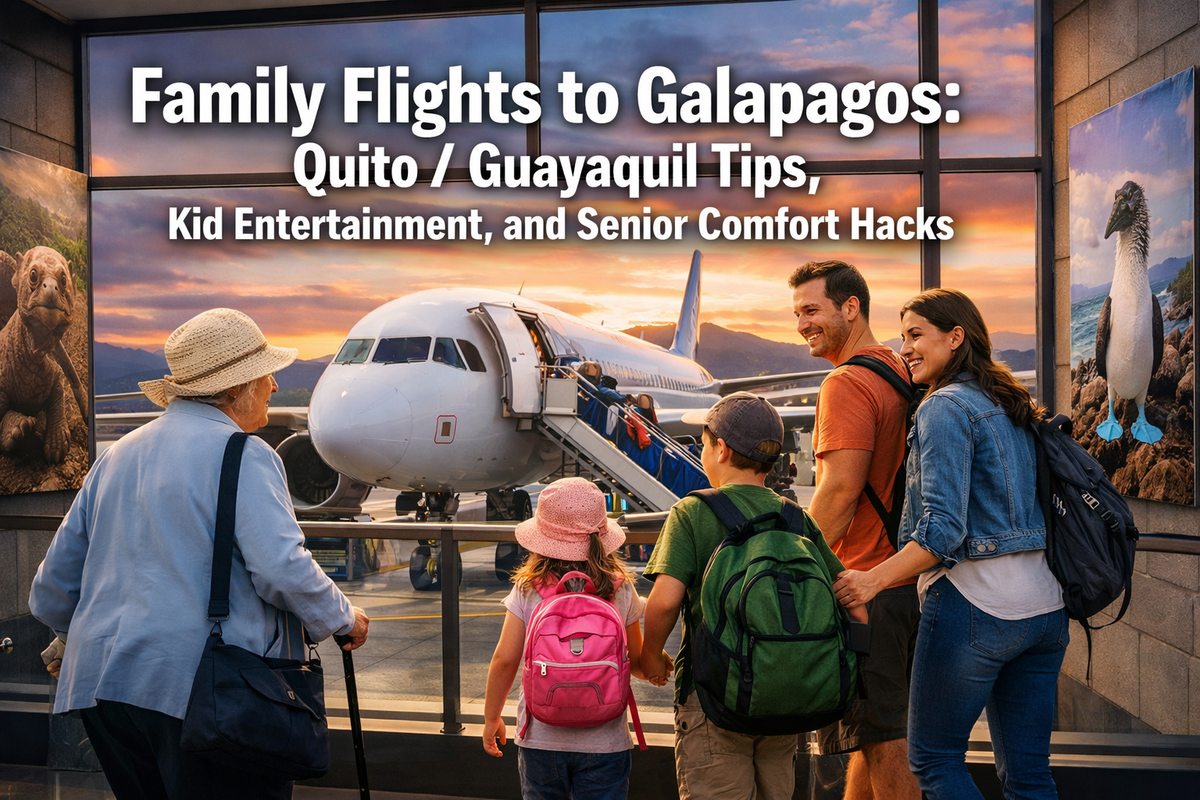
Family Flights to Galapagos: Quito/Guayaquil Tips, Kid Entertainment, and Senior Comfort Hacks
Last updated: March 11, 2026
Quick Answer
Family flights to Galapagos require choosing between Quito (longer flight, safer overnight, cooler climate) or Guayaquil (shorter flight, hotter, tighter schedule) as your mainland gateway, arriving two hours early for Transit Control Card processing and biosecurity checks, and planning age-specific comfort strategies for the 2-3.5 hour journey. Book LATAM or Avianca flights 3-4 months ahead for $350-500 round-trip economy fares, prepare $20 cash per person for the Transit Control Card, and pack sealed snacks while avoiding fresh produce to pass biosecurity inspection.
Key Takeaways
- Gateway choice matters: Quito offers safer overnight stays and UNESCO sightseeing but adds 1+ hour flight time; Guayaquil provides shorter flights (1h45m) but higher crime risk for stopovers
- Arrive two hours early for Transit Control Card ($20/person cash) and mandatory biosecurity bag inspection before boarding
- No same-day international connections work reliably due to immigration, TCT processing, and biosecurity requirements; overnight stays are essential
- Book 3-4 months ahead with LATAM or Avianca for best family fares ($350-500 round-trip economy as of early 2026) - $350 flights are available for locals, taxes at the end will end up reaching the $500
- Bring $200 cash/adult, $100/child for Galapagos National Park entry fee upon arrival (no cards accepted)
- Kids ages 5+ handle flights well with activity books, wildlife videos, and sealed snack packs; junior ranger programs available onboard cruises
- Seniors up to 80+ travel comfortably with aisle seats, compression socks, and low-activity itinerary choices
- Biosecurity is strict: no fresh fruits, vegetables, or seeds allowed; kids' sealed snacks pass inspection
- Morning departures from Quito (7:30-10AM) and Guayaquil (9AM-12PM) work best for family energy levels
- Cuenca now connects to Galapagos via Quito/Guayaquil stopovers (added November 2025), expanding southern Ecuador options
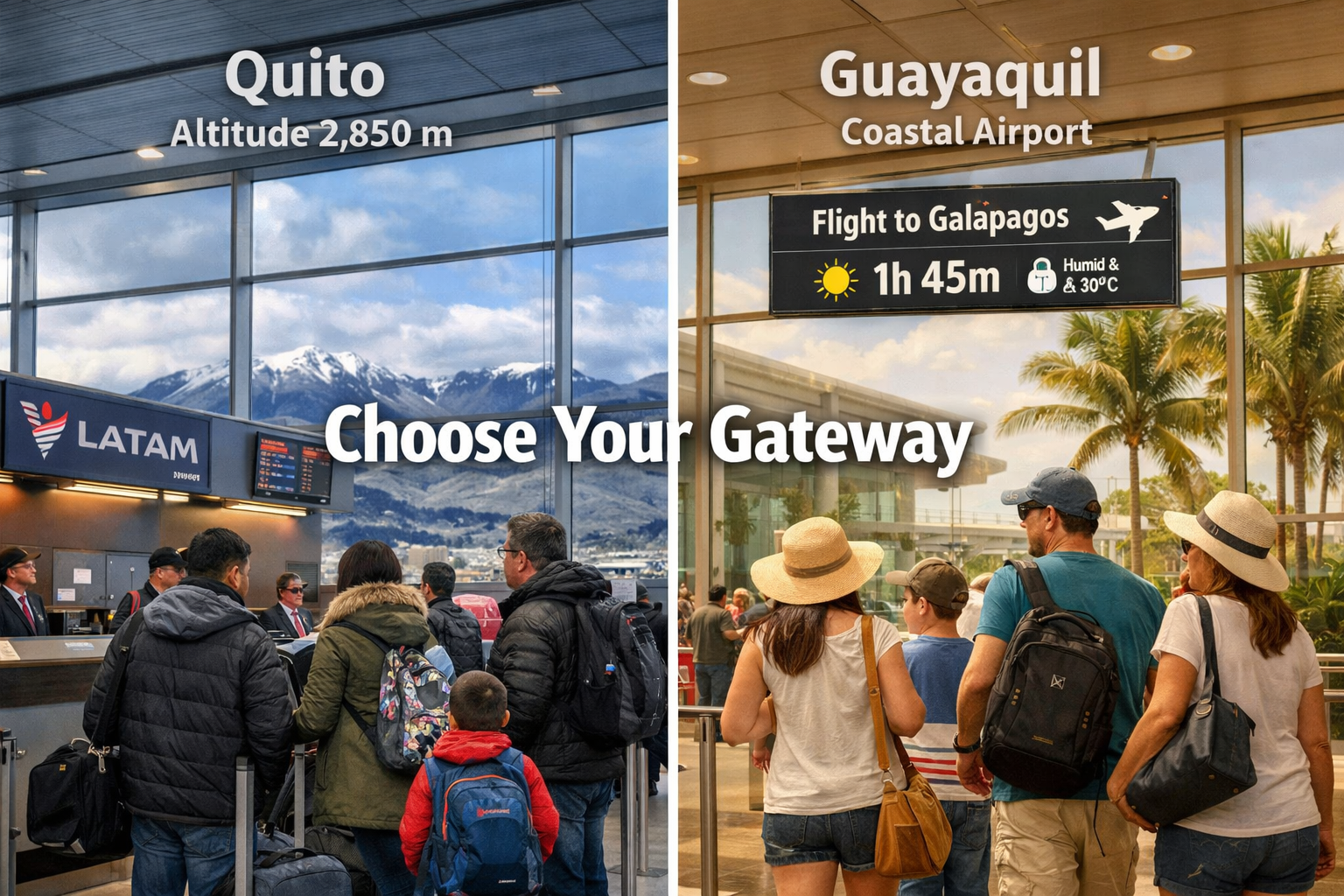
Should Your Family Fly from Quito or Guayaquil to Galapagos?
Choose Quito if you value safety and have an extra day; choose Guayaquil if you need the shortest possible flight time and tightest schedule.
I've guided hundreds of multigenerational families through this decision over the past 30 years. Here's what actually matters:
Quito advantages:
- Safer overnight accommodation (US State Department rates it lower risk than Guayaquil as of October 2025)
- UNESCO World Heritage old town offers memorable pre-trip sightseeing for grandparents
- Cooler climate (60-70°F year-round) easier on seniors sensitive to heat
- More hotel options near the airport in safe neighborhoods
Quito disadvantages:
- Flight time: 2h15m-2h30m, often with brief Guayaquil stopover adding up to 3h30m total
- Altitude 2,850m can cause mild headaches in sensitive family members (rare, but I've seen it)
- Slightly higher overnight costs
Guayaquil advantages:
- Shortest flight time: 1h45m-2h direct to Galapagos
- Sea-level city means no altitude concerns
- Warmer climate appeals to beach-loving families
Guayaquil disadvantages:
- Higher crime rates require careful hotel selection near airport (avoid downtown)
- Hot, humid weather (80-90°F) can exhaust seniors and young children during layovers
- Fewer family-friendly sightseeing options for overnight stays
My recommendation: Families with seniors or children under 8 should choose Quito. The safety factor and cooler climate outweigh the extra hour of flight time. I've watched too many families arrive stressed in Guayaquil's heat after long international flights.
Families with teens and active grandparents who want to maximize Galapagos time can handle Guayaquil's shorter route, but book hotels in the airport area (Wyndham or Hilton Colon), or luxury property like Hotel del Parque, not downtown.
How Early Should Families Arrive for Galapagos Flights?
Arrive exactly two hours before departure to complete Transit Control Card processing and biosecurity inspection without rushing young children or seniors.
This isn't negotiable. I've seen families miss flights by cutting it close.
The two-hour window covers:
- Transit Control Card (TCT) purchase: $20 cash per person, obtained at special counters before check-in
- Airline check-in: Standard process, but bags get sealed after inspection
- Biosecurity inspection: All luggage scanned and inspected for prohibited organic materials
- Bag sealing: Inspectors seal checked bags with special tape post-inspection
- Security checkpoint: Standard airport security
- Gate walk: Quito and Guayaquil airports require 10-15 minute walks to Galapagos gates
*Tour Operators like Voyagers Travel offer airport assistance and fill out all paperwork for you
Family-specific timing tips:
- Seniors with mobility aids: Add 15 minutes for wheelchair assistance coordination
- Families with children under 5: Add 10 minutes for bathroom breaks during the process
- Groups of 6+: Add 10 minutes as TCT counters process one person at a time
Morning departure reality: Quito flights leave 7:30-10AM, Guayaquil 9AM-12PM [9]. For a 9AM Guayaquil departure, that means leaving your hotel by 6:30AM. Factor this into your overnight planning.
I always tell families: set your alarm earlier than feels comfortable. A relaxed two-hour buffer beats a panicked sprint with grandma and toddlers.
What Can't Families Bring Through Galapagos Biosecurity?
No fresh fruits, vegetables, seeds, soil, or unsealed food items pass biosecurity inspection; sealed, processed snacks for kids are fine.
Biosecurity protects the islands' unique ecosystem. Inspectors take this seriously, and I support them completely.
Prohibited items that catch families:
- Fresh apples, bananas, or oranges packed for kids
- Homemade sandwiches with lettuce or tomatoes
- Trail mix with raw nuts or dried fruit (if unsealed)
- Flowers or plants (even pressed ones in books)
- Soil on hiking boots from previous trips
- Seeds in any form
What kids can bring:
- Factory-sealed granola bars, crackers, cookies
- Sealed juice boxes or pouches
- Packaged chips or pretzels
- Sealed candy or gum
- Store-bought sealed trail mix
What happens during inspection: Your bags go through X-ray scanners. Inspectors open suspicious bags and hand-search them. If they find prohibited items, you surrender them on the spot. No arguments, no exceptions.
After inspection, bags get sealed with official tape. Don't break this seal or you'll face questions upon Galapagos arrival.
My packing hack: Buy kids' snacks at Quito or Guayaquil airport stores after international arrival but before the Galapagos biosecurity checkpoint. These items pass inspection because they're sealed and locally sourced.
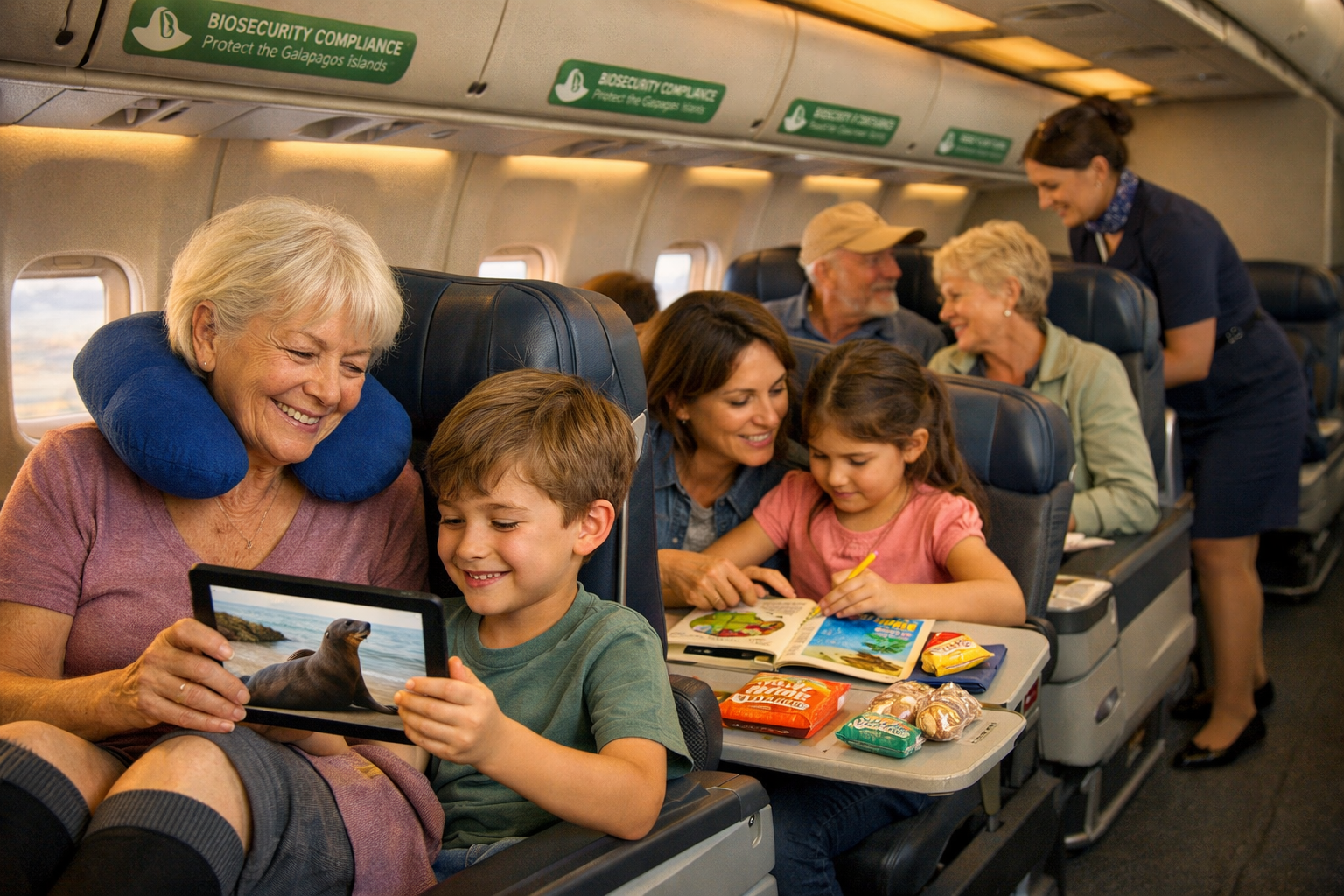
How Do You Keep Kids Entertained on Family Flights to Galapagos?
Load tablets with Galapagos wildlife documentaries, pack activity books featuring islands' animals, and bring sealed snacks to maintain energy during the 2-3.5 hour flight.
Kids ages 5+ handle these flights well if you prepare properly. I've seen it work hundreds of times.
Pre-flight preparation (do this at home):
- Download 2-3 age-appropriate Galapagos documentaries (David Attenborough's work, BBC Earth)
- Print or buy Galapagos coloring books featuring blue-footed boobies, sea lions, iguanas
- Create a "spot the animal" bingo card with species they'll see
- Pack noise-canceling headphones (cabin noise bothers some kids)
In-flight entertainment by age:
Ages 5-8:
- Coloring books with Galapagos themes
- Simple wildlife identification cards (make these yourself with photos and facts)
- Window seat assignments to watch clouds and ocean
- Sealed fruit snacks distributed every 30 minutes
Ages 9-12:
- Tablets with wildlife documentaries and games
- Junior naturalist journals to draw observations
- Galapagos species field guides (National Geographic publishes good ones)
- Camera to photograph clouds and cabin (builds excitement)
Teens:
- Photography planning (what shots they want in Galapagos)
- Research assignments (pick three species to become the "expert" on)
- Music playlists with downloaded content (Wi-Fi isn't available)
- Sketching supplies if artistically inclined
Snack strategy: Distribute sealed snacks every 45 minutes. Low blood sugar makes kids cranky at 30,000 feet. I recommend granola bars, crackers, and juice boxes purchased at mainland airports after international arrival.
Seat assignments matter: Book window seats for kids who love views, aisle seats for kids who need bathroom access. Middle seats are misery for everyone.
One family I guided gave their 7-year-old a disposable camera for the flight. She photographed everything, stayed engaged, and created a pre-Galapagos photo album. Brilliant.
What Comfort Hacks Help Seniors on Family Flights to Galapagos?
Book aisle seats for easy bathroom access, bring compression socks for circulation, pack neck pillows and light sweaters for cabin temperature changes, and request early boarding to avoid gate rushing.
Seniors up to 80+ travel comfortably to Galapagos if you plan for their specific needs. I've guided active grandparents well into their 70s who handled flights better than their grandchildren.
Pre-booking essentials:
- Aisle seats: Non-negotiable for bathroom access and leg stretching
- Extra legroom rows: Worth the $20-40 upcharge for 2+ hour flights
- Early boarding: Request this at check-in; most airlines accommodate seniors
- Wheelchair assistance: Free service from check-in to gate if needed (request 24 hours ahead)
Packing list for senior comfort:
| Item | Purpose | Priority |
|---|---|---|
| Compression socks | Prevent leg swelling on 2-3 hour flights | High |
| Neck pillow | Support during potential naps | High |
| Light sweater/jacket | Cabin temperatures fluctuate 65-75°F | High |
| Prescription medications | Carry-on only, in original bottles | Critical |
| Eyeglasses case | Protect glasses during naps | Medium |
| Hand sanitizer | Hygiene without bathroom trips | Medium |
| Earplugs | Block engine noise | Low |
| Empty water bottle | Fill post-security for hydration | High |
Medication timing: If seniors take morning medications, coordinate with early departure times. A 7:30AM Quito flight means taking meds at 5:30-6AM at the hotel.
Hydration strategy: Airplane cabins dry out seniors faster than younger passengers. Fill a water bottle after security and encourage sips every 20 minutes. Dehydration causes headaches and fatigue that ruin the first Galapagos day.
Bathroom timing: Use the airport bathroom immediately before boarding. Use the aircraft bathroom 30 minutes into the flight when seatbelt signs turn off. Avoid waiting until the last 30 minutes when turbulence often requires seatbelts.
My personal observation: Seniors who walk the airport terminal for 10 minutes before boarding (instead of sitting at the gate) report better in-flight comfort. Movement before sitting 2+ hours makes a difference.
I once guided a 78-year-old grandmother with knee arthritis. Aisle seat, compression socks, early boarding, and a neck pillow made her flight smoother than her daughter's in a middle seat.
How Much Do Family Flights to Galapagos Cost in 2026?
Round-trip economy fares from Quito or Guayaquil to Galapagos cost $350-500 per person when booked 3-4 months ahead with LATAM or Avianca as of early 2026.
Price varies by season, booking timing, and airline. Here's what families actually pay:
Pricing by booking window:
- 3-4 months ahead: $350-450 per adult, $300-400 per child (best value)
- 1-2 months ahead: $450-550 per adult, $400-500 per child
- Last minute (under 3 weeks): $600-800 per adult, $550-700 per child
*When booking your flights with the cruise operator pricing is frozen around $500-550 regardless of season and timing
Seasonal price patterns:
- High season (June-August, December-January): Upper end of ranges
- Shoulder season (April-May, September-November): Middle ranges
- Low season (February-March): Lower end, but weather less predictable
Airline comparison (early 2026 data):
- LATAM: Slightly higher fares but more flight frequency, better on-time record
- Avianca: Competitive pricing, one-way fares from international hubs as low as $207 (promotional, limited availability)
Family cost example (4 people: 2 adults, 2 kids ages 8 and 12):
- Flights booked 3 months ahead: $1,600-1,800 round-trip
- Transit Control Cards: $80 ($20 × 4)
- Galapagos National Park entry: $500 ($200 × 2 adults + $100 × 2 kids)
- Total flight-related costs: $2,180-2,380
Money-saving strategies:
- Book exactly 3-4 months out (sweet spot for availability and price)
- Fly Tuesday-Thursday (cheaper than weekend departures)
- Choose Guayaquil over Quito if price difference exceeds $100/person (shorter flight offsets savings)
- Join LATAM or Avianca frequent flyer programs before booking (earn miles for future trips)
Hidden costs families miss:
- Overweight baggage ($50-100 per bag over 50 lbs)
- Seat selection fees ($15-40 per seat for preferred rows)
- Airport parking or taxi to mainland airport ($20-60)
I tell families to budget $2,500-3,000 for all flight-related expenses for a family of four. Undercutting this creates stress when the National Park entry fee hits you with $500 cash requirement at Baltra or San Cristobal.
Can Families Connect Same-Day from International Flights to Galapagos?
No, same-day connections from international arrivals to Galapagos flights don't work reliably due to immigration processing, Transit Control Card requirements, and biosecurity inspection timing; overnight stays in Quito or Guayaquil are essential.
I've watched families try this. It fails more often than it succeeds.
Why same-day connections fail:
- Immigration delays: International arrivals at Quito or Guayaquil can take 30-90 minutes during peak times
- Baggage claim wait: 20-45 minutes for checked bags
- Transit Control Card line: 15-30 minutes during busy morning hours
- Biosecurity inspection: 20-40 minutes with family luggage
- Re-check-in process: 15-20 minutes
- Security checkpoint: 15-25 minutes
- Gate distance: 10-15 minute walk in both airports
Total realistic time: 2.5-4 hours from international landing to Galapagos departure gate.
The math doesn't work: If your international flight lands at 6AM and the last Galapagos departure leaves at 7AM, you'd need to complete all steps in 1 hour. Impossible with a family.
Overnight stay benefits:
- Rest after long international flights (especially for seniors and young kids)
- Buffer against international flight delays
- Time to purchase any forgotten items
- Opportunity to experience Quito's UNESCO old town or Guayaquil's Malecon waterfront
- Reduced stress on travel day
Where to stay:
Quito (recommended):
- Wyndham Quito Airport (5 minutes from terminal, safe, family rooms)
- Holiday Inn Quito Airport (shuttle service, kid-friendly pool)
- ILLA Experience Hotel Quito (45 minutes from airport, in the middle of the UNESCO downtown, pool, kid friendly experiences)
Guayaquil:
- Wyndham Guayaquil Airport (attached to terminal, maximum convenience)
- Hilton Colon Guayaquil (airport area, safe, good restaurants)
- Hotel del Parque (safe area, own zoo and historic park)
I've guided families who ignored this advice and missed their Galapagos flights due to international delays. The rebooking fees ($200-400 per person) and lost cruise departure costs ($1,000s) far exceed a $120 hotel night.
Plan the overnight. Sleep well. Catch your Galapagos flight relaxed.
What Airlines Fly Families to Galapagos and How Often?
LATAM and Avianca operate multiple daily flights from Quito and Guayaquil to Baltra (GPS) and San Cristobal (SCY) islands, with morning departures 7:30AM-12PM and midday returns 10AM-2PM.
Two airlines dominate this route. Both are reliable for family travel.
LATAM:
- Fleet: Modern Airbus A320 aircraft, comfortable for families
- Frequency: 2-3 daily flights from Quito, 3-4 from Guayaquil
- Destinations: Baltra (GPS) and San Cristobal (SCY)
- Departure times: Quito 7:30-10AM, Guayaquil 9AM-12PM
- Return times: Depart Galapagos 10AM-2PM, arrive Guayaquil 1-4:30PM, Quito 3-7PM [9]
- Family perks: Priority boarding for families with young children, decent legroom (31-32 inches)
Avianca:
- Fleet: Airbus A319/A320, similar comfort to LATAM
- Frequency: 1-2 daily flights from Quito, 2-3 from Guayaquil
- Destinations: Baltra (GPS) and San Cristobal (SCY)
- Departure times: Quito 7:30-10AM, Guayaquil 9AM-12PM
- Pricing: Competitive with LATAM, occasional promotional fares [7]
- Family perks: LifeMiles program offers family pooling of points
Route options (as of November 2025):
- Quito (UIO) → Baltra (GPS): Most common, often stops briefly in Guayaquil
- Quito (UIO) → San Cristobal (SCY): Less frequent, direct
- Guayaquil (GYE) → Baltra (GPS): Most frequent, direct
- Guayaquil (GYE) → San Cristobal (SCY): Daily options
- NEW: Cuenca → Galapagos via Quito or Guayaquil connection
Which airline should families choose?
Choose LATAM if:
- You want maximum flight frequency and flexibility
- Your cruise departs from Baltra (most common)
- You value slightly better on-time performance
Choose Avianca if:
- You find promotional fares significantly cheaper
- You're already in their LifeMiles program
- Schedule aligns perfectly with your needs
My honest take: I fly both airlines regularly with families. The experience is nearly identical. Choose based on price and schedule, not airline preference. A $100/person savings with Avianca buys a nice family dinner in Puerto Ayora.
*When booking a cruise, book your flight with the cruise operator, you arrive together and have the free transfer to the yacht
What Should Families Know About Galapagos Airport Arrival?
Upon landing at Baltra or San Cristobal, families must show Transit Control Cards, pass through another biosecurity inspection with bag rescanning, and pay the Galapagos National Park entry fee of $200 cash per adult and $100 per child under 12.
The journey isn't over when you land. One more checkpoint awaits.
Arrival sequence:
- Deplane: Walk across tarmac to small terminal (no jet bridges)
- Show Transit Control Card: Officers verify the $20 card you bought on mainland
- Biosecurity bag rescan: All luggage goes through X-ray again (checking for items acquired during mainland stay)
- National Park fee payment: Cash-only window, $200/adult, $100/child under 12
* Tour and cruise operators can prepay this for you - Baggage claim: Small carousel, 5-10 minute wait
- Exit to transportation: Taxis, buses, or cruise representatives
Total time from landing to exit: 30-45 minutes with a family of 4-6.
Cash requirement reality check:
Family of 4 (2 adults, 2 kids ages 8 and 12):
- National Park fees: $500 cash
- Tips for baggage handlers: $5-10
- Bus or taxi to dock/hotel: $5-20
- Bring minimum: $550 cash USD
ATMs exist in Puerto Ayora and San Cristobal town, but not at airports. Don't arrive without sufficient cash.
What if you don't have enough cash?
I've seen this disaster. Officers direct you to a small office where you can sometimes pay by credit card with a 5-10% surcharge, but this isn't guaranteed. Some families have missed cruise departures dealing with payment issues.
Biosecurity rescan catches:
- Fresh fruit purchased at Quito/Guayaquil airport after your initial scan
- Plants or flowers bought as gifts
- Unsealed food items acquired during overnight stay
My pre-landing checklist for families:
- ✓ Transit Control Cards in hand (don't pack them)
- ✓ Cash counted and accessible ($500+ for family of 4)
- ✓ Passports ready
- ✓ Carry-on bags organized (you'll open them for inspection)
FAQ
Q: Can toddlers under 3 fly to Galapagos comfortably?
Yes, children under 3 fly free as lap infants on most carriers, but families with toddlers should book extra legroom seats for diaper changes and movement space during the 2-3.5 hour flight. Bring sealed snacks, favorite toys, and download age-appropriate entertainment.
Q: Do seniors need special medical clearance for Galapagos flights?
No medical clearance is required for commercial flights to Galapagos, but seniors with serious heart or respiratory conditions should consult doctors about the brief Quito altitude exposure (2,850m) if connecting through that city. Guayaquil is sea-level and poses no altitude concerns.
Q: Are there family discounts on Galapagos flights?
Airlines don't offer family discounts on flights, but children under 12 pay reduced Galapagos National Park entry ($100 vs. $200), and many cruises offer 25-50% child discounts when sharing cabins with parents.
Q: What happens if our international flight delays and we miss the Galapagos connection?
Airlines will rebook you on the next available flight at no charge if both flights are on the same ticket, but if booked separately you'll pay rebooking fees ($200-400/person) plus potential cruise departure penalties (cruise lines will depart on time, to reach a cruise at mid sea you are looking at $1000's for an uncomfortable private speed boat ride). This is why overnight stays are essential.
Q: Can families bring strollers on Galapagos flights?
Yes, strollers check free at the gate and return upon landing. However, Galapagos islands have limited paved surfaces, making strollers impractical for most activities.
Q: Is travel insurance worth it for family Galapagos flights?
Absolutely. Comprehensive travel insurance ($150-300 for a family of 4) covers flight cancellations, medical emergencies, and trip interruptions. Given the $2,000-3,000 flight investment plus cruise costs, insurance provides essential protection.
Q: How far in advance should we book Galapagos flights for a family of 6+?
Book 4-5 months ahead for groups of 6 or more to secure seats together and access the best fares. Large families booking last-minute often face split seating and premium pricing.
Q: Can we use frequent flyer miles for family Galapagos flights?
Yes, both LATAM and Avianca accept miles for Galapagos routes, typically requiring 15,000-25,000 miles one-way per person. Book award seats 6+ months ahead as availability is limited, especially during high season.
Q: What's the baggage allowance for families flying to Galapagos?
LATAM and Avianca allow one checked bag (50 lbs) and one carry-on per person on Galapagos routes. Families often underpack since cruise ships provide wetsuits and snorkel gear, reducing luggage needs.
Q: Are there direct flights from the US to Galapagos?
No, all flights to Galapagos require connections through mainland Ecuador (Quito or Guayaquil). US families typically fly to Quito or Guayaquil first, overnight, then continue to Galapagos the next day.
Q: Do kids need passports for Galapagos flights?
Yes, all travelers regardless of age need valid passports for Ecuador and Galapagos. Children's passports are valid for 5 years (vs. 10 for adults), so check expiration dates well before booking.
Q: What's the best seat configuration for a family of 5?
Book a three-seat row for parents and youngest child, plus a two-seat row for older siblings. This keeps the family close while giving teens some independence and parents easier access to toddlers.
Conclusion
Planning family flights to Galapagos comes down to three critical decisions: choosing between Quito's safety and Guayaquil's speed, booking 3-4 months ahead for reasonable fares, and preparing age-specific comfort strategies for your multigenerational crew.
I've spent three decades guiding families through these logistics. The ones who arrive relaxed and ready for adventure share common traits: they overnight in mainland Ecuador instead of rushing same-day connections, they bring sufficient cash for the $500+ family entry fees, and they pack sealed snacks while respecting biosecurity rules.
Your grandparents will appreciate those aisle seats and compression socks during the flight. Your kids will stay engaged with wildlife documentaries and Galapagos coloring books. And you'll thank yourself for arriving two hours early when you breeze through Transit Control Card processing while other families sprint to their gates.
The Galapagos islands reward families who plan thoughtfully. Start with your flights. Get those details right, and everything else falls into place.
Your next steps:
- Choose Quito or Guayaquil based on your family's safety priorities and schedule
- Book LATAM or Avianca flights 3-4 months before your target departure
- Reserve hotel rooms near your chosen mainland airport for overnight stays
- Prepare $200 cash per adult, $100 per child for National Park entry
- Download this article and share it with your traveling family members
The blue-footed boobies, sea lions, and giant tortoises are waiting. Let's get your family there comfortably.
Galapagos flights, family travel Ecuador, Quito to Galapagos, Guayaquil flights, multigenerational travel, Galapagos with kids, senior travel tips, LATAM Ecuador, Avianca Galapagos, family vacation planning, Ecuador travel guide, Galapagos National Park