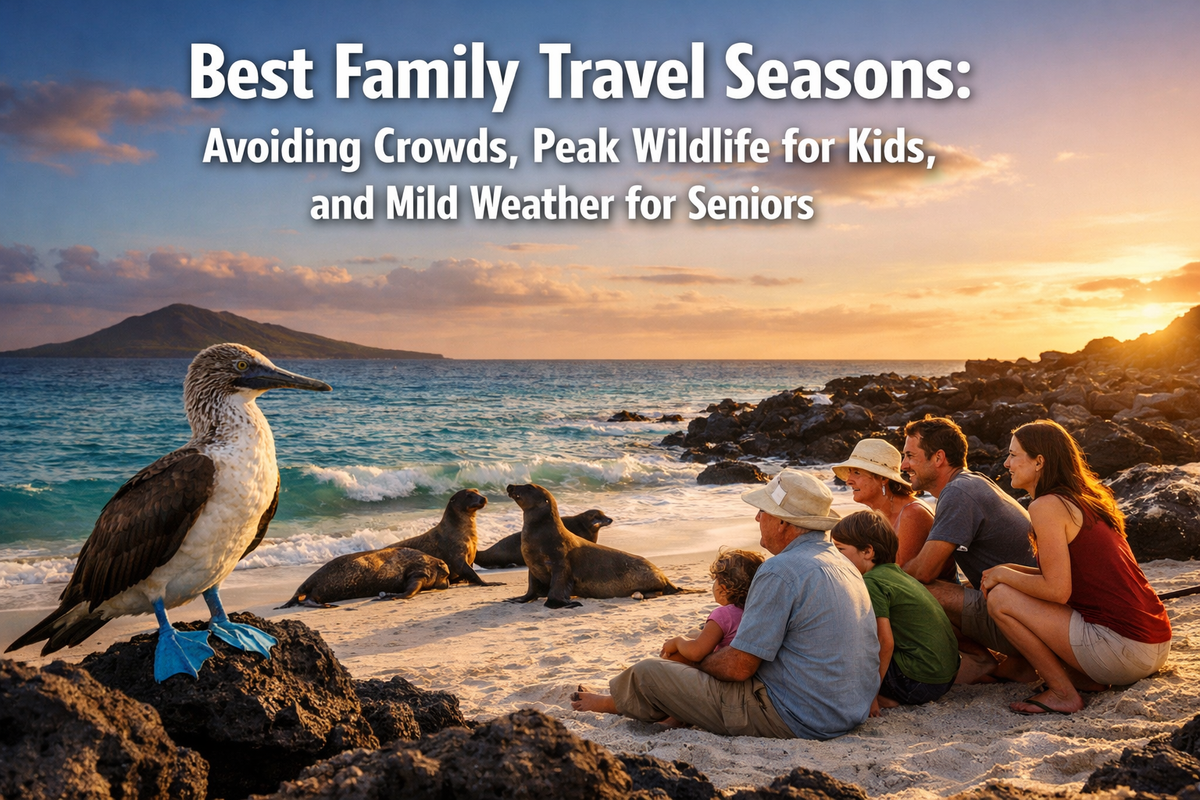
Best Family Travel Seasons: Avoiding Crowds, Peak Wildlife for Kids, and Mild Weather for Seniors
Last updated: March 11, 2026
Quick Answer
The best family travel seasons for Ecuador and the Galapagos are April-May and September-November. These shoulder months deliver calm seas for seniors, active baby wildlife for kids, and far fewer cruise ships than June-August peaks. You'll pay 20-30% less and actually see animals without elbowing through crowds at every viewpoint.
Key Takeaways
- April-May offers baby sea lions and nesting season – playful pups on beaches, blue-footed boobies courting, mild 70-75°F weather perfect for grandparents
- September-November brings marine life peaks – whale sharks, manta rays, and penguin activity increase while cruise bookings drop 40% post-summer
- Avoid June-August and December-January – these are peak tourist months with double the visitors and premium pricing
- Shoulder seasons cut costs significantly – expect 20-30% savings on cruises and lodging compared to high season
- Weather stays mild year-round in Galapagos – water temps range 65-75°F, air temps 70-85°F, making any month workable for seniors
- Book 6-12 months ahead for shoulder seasons – best availability disappears fast as savvy families discover these windows
Why Shoulder Seasons Matter for Multigenerational Galapagos Travel
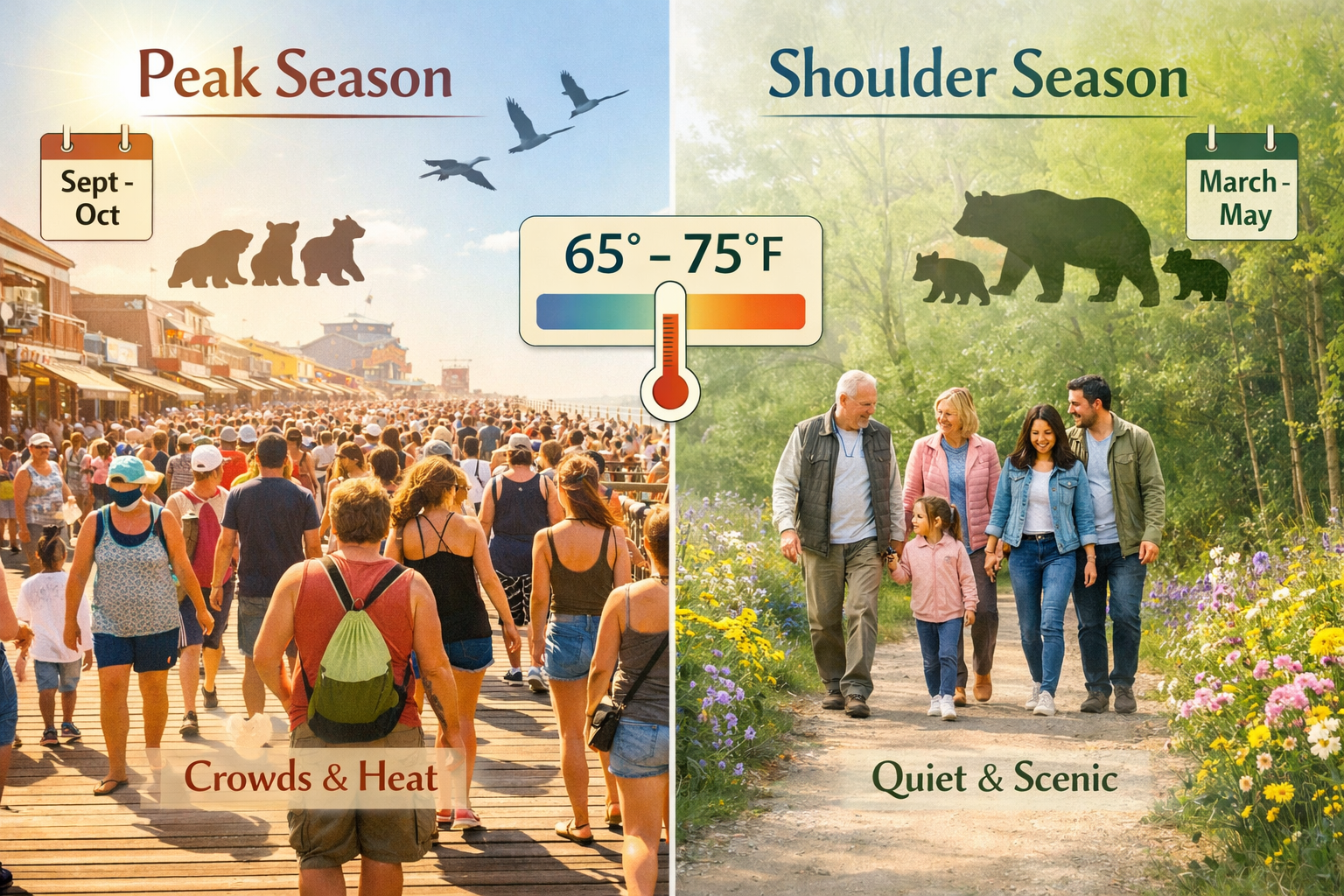
Shoulder seasons (April-May and September-November) give multigenerational families the best of everything: comfortable pacing for seniors, exciting wildlife for kids, and breathing room at landing sites. I've guided families through peak July weeks where 16 boats converge at a single site, and I've led the same itinerary in May with just 3 other vessels. The difference is night and day.
The crowd factor changes everything. When you're traveling with grandparents who need time to navigate wet landings and grandkids who want to linger watching sea lion pups play, you can't afford to be rushed by the next group waiting their turn. Shoulder seasons give you that time.
National parks worldwide show the same pattern – spring and fall deliver fewer visitors, better wildlife viewing as animals avoid peak-season crowds, and milder temperatures without summer extremes.[4] The Galapagos amplifies these benefits because the islands limit daily visitor permits. During shoulder months, those permits don't sell out weeks in advance.
What Makes a Season "Shoulder" in the Galapagos
The Galapagos operates on two unofficial seasons:
Warm/wet season (December-May):
- Water temps: 70-75°F
- Air temps: 75-85°F
- Occasional afternoon showers (brief, warm)
- Calmer seas, better for seniors prone to seasickness
Cool/dry season (June-November):
- Water temps: 65-70°F
- Air temps: 70-75°F
- Overcast mornings, sunny afternoons
- Rougher seas from Humboldt Current, more nutrients = more marine life
The shoulder sweet spots are April-May (end of warm season) and September-November (heart of cool season after peak crowds leave). April-May gives you warm water and baby animals. September-November delivers the best underwater visibility and marine megafauna.
When Wildlife Peaks for Kids (and Why Timing Matters)
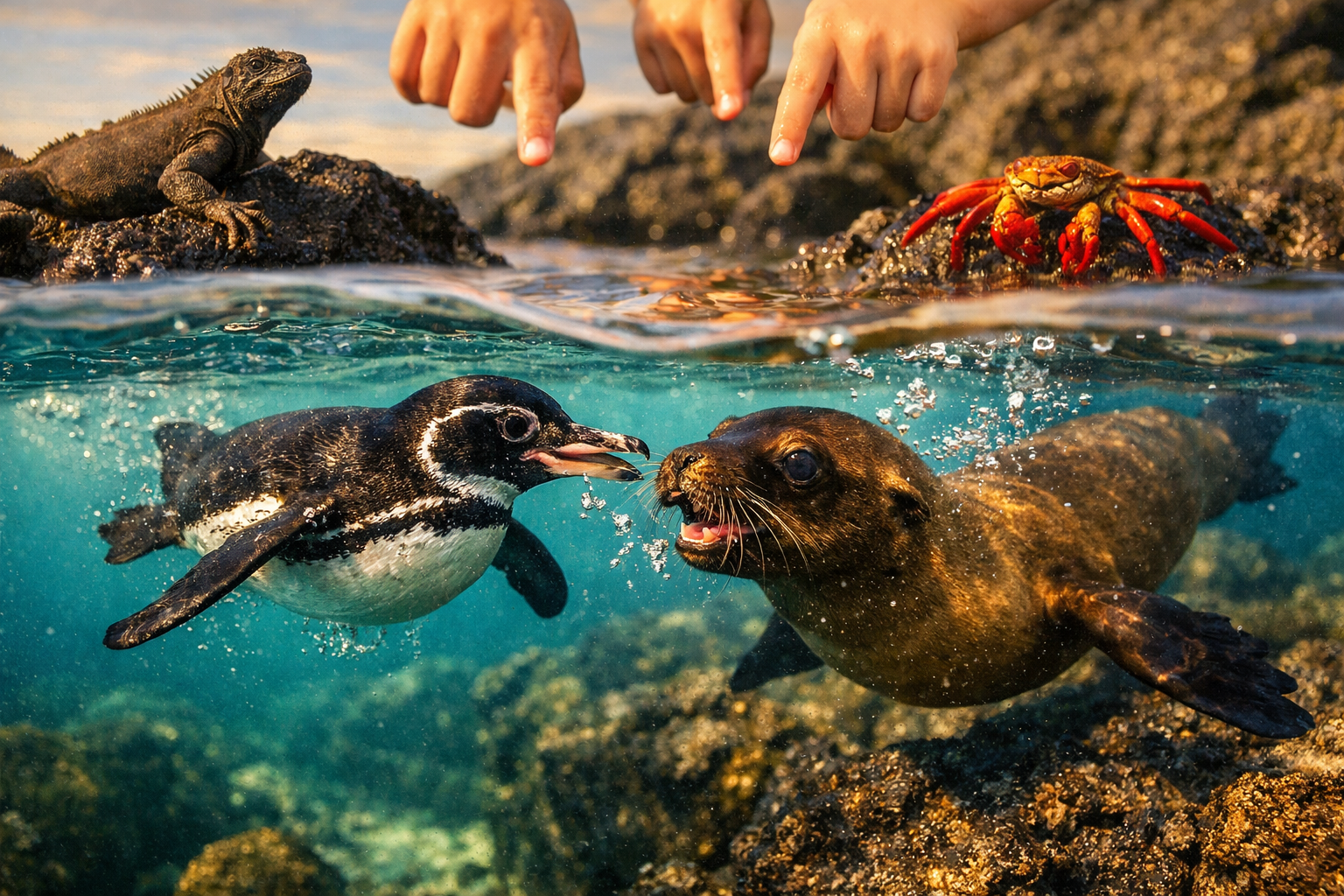
Kids don't care about crowd theory. They want to see baby sea lions nursing, watch frigatebirds inflate their red throat pouches, and snorkel with penguins. Timing your trip to wildlife cycles makes or breaks a family Galapagos experience.
April-May wildlife highlights:
- Sea lion pupping season – beaches covered with playful pups learning to swim
- Blue-footed booby courtship – males perform their famous sky-pointing dance
- Marine iguana nesting – females dig nests on beaches, males turn bright red and green
- Giant tortoise hatching – tiny tortoises emerge at breeding centers
September-November wildlife highlights:
- Whale shark season peaks – especially around Darwin and Wolf Islands (advanced divers only, but snorkelers see mantas)
- Galapagos penguin activity increases – cooler water brings more fish, more hunting behavior
- Sea lion mating displays – bulls establish territories with dramatic barking contests
- Waved albatross courtship – Española Island, bill-circling and sky-pointing (April-December, peaks mid-season)
I've watched kids' faces light up more during a May trip when we encountered 40+ sea lion pups on a single beach than during a July trip where we saw adults but only a handful of young. The density of baby animals in shoulder months is unmatched.
Common mistake: Families assume "summer vacation = best wildlife." Wrong. June-August is actually a transition period between breeding cycles. You'll see wildlife, but not the concentrated baby animal activity that mesmerizes children.
Finding Mild Weather Windows for Senior Comfort
I prioritize senior comfort on every trip because pace determines whether a family thrives or merely survives a Galapagos adventure. Weather directly impacts that pace.
Best months for senior-friendly weather:
| Month | Water Temp | Air Temp | Sea Conditions | Senior Comfort Rating |
|---|---|---|---|---|
| April | 72-75°F | 78-82°F | Calm | Excellent |
| May | 70-74°F | 75-80°F | Calm to moderate | Excellent |
| September | 66-68°F | 70-74°F | Moderate | Good |
| October | 65-67°F | 70-75°F | Moderate to rough | Good |
| November | 66-69°F | 72-76°F | Moderate | Very Good |
April-May wins for seniors who:
- Get seasick easily (calmer seas)
- Prefer warmer water for snorkeling (less wetsuit bulk)
- Dislike overcast skies (more consistent sunshine)
- Need predictable weather for pacing activities
September-November works for seniors who:
- Handle cooler water with 3mm wetsuits
- Don't mind morning clouds (burns off by noon)
- Prioritize marine life over weather perfection
- Want the absolute lowest crowds
Real example: Last November, I guided a family with an 82-year-old grandmother. She snorkeled every day in a 3mm wetsuit, loved the cooler air temps for hiking, and never complained about the occasional chop between islands. But I've also had 68-year-olds in July who struggled with heat exhaustion on midday hikes. Know your seniors' tolerances.
Choose April-May if your seniors prioritize comfort over marine spectacle. Choose September-November if they're adventurous and want the full Galapagos experience.
How to Actually Avoid Crowds in the Galapagos
The Galapagos National Park limits daily visitors to each site, but that doesn't mean you'll have beaches to yourself in July. Here's how to genuinely minimize crowds:
1. Book shoulder season departures (April-May, September-November) Peak months (June-August, December-January) see 60-70% higher visitor numbers.[1] Shoulder months cut that density significantly.
2. Choose smaller boats (16 passengers or fewer) Smaller vessels access the same sites but move faster through rotations. You're not waiting behind a 100-passenger ship's worth of pangas.
3. Prioritize early morning and late afternoon landings Your naturalist guide controls timing. Request first or last slots at popular sites like Bartolomé or North Seymour.
4. Avoid holiday weeks entirely Christmas/New Year and Easter week bring South American family tourism surges. Even shoulder months get crowded during these windows.
5. Consider land-based itineraries with daily boat trips You'll visit less-trafficked sites that big cruise ships skip. Perfect for seniors who prefer sleeping in a stable bed.
Crowd reality check: I've done back-to-back departures in May and July on identical itineraries. The May trip had 4-6 boats at popular sites. The July trip had 12-16 boats. That's triple the people competing for the same sea lion colony photo op. For families with seniors who need time and kids who want to explore, those numbers matter.
Booking Timeline: When to Reserve for Best Availability
The best family travel seasons for avoiding crowds require counterintuitive booking strategies. Everyone thinks "shoulder season = last-minute deals." Sometimes true for couples. Never true for families needing adjoining cabins.
Optimal booking windows:
For April-May departures:
- Book 8-12 months ahead (by June-August of previous year)
- Prime family cabins (interconnecting, lower deck for stability) sell out first
- Last-minute deals appear 4-6 weeks out, but you'll get whatever's left
For September-November departures:
- Book 6-10 months ahead (by December-March)
- Slightly more availability than April-May
- November Thanksgiving week books early (Americans traveling)
Why early booking matters for families: You need specific cabin configurations. A couple can take any cabin. A family with grandparents needs lower-deck stability, kids need proximity to parents, and everyone needs bathrooms that accommodate mobility. Those cabins go first.
I've seen families wait for "deals" and end up with grandparents on Deck 3, parents on Deck 1, kids on Deck 2. Nobody slept well. The $400 they saved cost them the trip's enjoyment.
Book early, negotiate later. Many operators offer price matching if rates drop. You secure the cabin configuration and maintain flexibility on price.
Comparing Galapagos Seasons to Other Family Wildlife Destinations
Families often ask how Galapagos timing compares to other wildlife destinations. Here's the honest comparison:
Galapagos (April-May, September-November) vs. alternatives:
Alaska (May, September):[6][10]
- Similar shoulder season logic – May for baby animals, September for fewer crowds
- Alaska's weather is less predictable (more rain, colder)
- Galapagos offers better senior comfort (warmer, shorter distances between sites)
- Alaska wins for dramatic landscapes, Galapagos wins for wildlife proximity
Costa Rica (April-May, November):[1]
- Shoulder months align almost perfectly with Galapagos
- Costa Rica is more affordable (30-40% less than Galapagos)
- Galapagos offers unique species (penguins, marine iguanas, flightless cormorants)
- Costa Rica provides easier logistics for families (drive between sites vs. boat-dependent)
Yellowstone (April-May, September-October):[8]
- Spring brings baby bears, bison calves, and elk – excellent for kids
- Fall delivers rutting season and migrating raptors
- Yellowstone is significantly cheaper and more accessible for seniors with mobility issues
- Galapagos offers snorkeling and marine life Yellowstone can't match
South Africa (October-March):
- Summer season for safaris, opposite Galapagos timing
- Allows families to combine both in one year (Galapagos April-May, South Africa November-December)
- South Africa offers Big Five, Galapagos offers marine biodiversity
- Both require significant travel investment
The Galapagos advantage: You can snorkel with penguins, sea lions, and sea turtles in the same day your grandparents walked among giant tortoises. No other destination combines that accessibility with that diversity.
Practical Trip Planning: Pace and Comfort Decisions
I'm critical of itineraries that prioritize "seeing everything" over family cohesion. Multigenerational trips fail when you push too hard. Here's how to build a comfortable Galapagos experience:
Recommended trip length by family composition:
Families with seniors 70+ or kids under 8:
- 5-6 day cruise (hits highlights without exhaustion)
- Land-based option with daily boat trips (more rest time)
- Focus on central islands (shorter navigation times)
Families with active seniors and kids 8-16:
- 7-8 day cruise (full experience without rushing)
- Western islands itinerary (Isabela, Fernandina – best wildlife)
- Balance snorkeling and hiking days
Adventure families (active seniors, teens):
- 10-15 day combination (land-based + cruise)
- Include diving add-ons (Gordon Rocks, Kicker Rock)
- Northern islands if certified divers (Darwin, Wolf – advanced only)
Daily pacing rules I enforce:
- No more than 2 activities before lunch (1 landing + 1 snorkel OR 2 short landings)
- Mandatory 1-hour rest after lunch (seniors need it, kids won't admit they need it)
- Alternate high-energy and low-energy days
- Build in 1 "light day" per week (short walks, beach time, onboard naturalist talks)
Real scenario: I once guided a family who wanted to "maximize" their 8-day trip. Grandpa (74) pushed through day 1-3, then spent day 4-5 in his cabin with exhaustion. We missed Española Island (his most anticipated stop) because he couldn't safely navigate the rocky landing. Pace matters more than checklist completion.
Weather Patterns and What They Mean for Daily Activities
Understanding Galapagos microclimates helps you pack correctly and set realistic expectations.
April-May weather patterns:
- Morning: Sunny, calm, 75-80°F
- Midday: Hot, 82-85°F, occasional brief showers
- Afternoon: Clearing, excellent for snorkeling (best visibility)
- Evening: Warm, calm seas for navigation
What to pack: Lightweight long sleeves (sun protection), rain jacket (brief showers), 1-2mm wetsuit or rash guard (warm water), reef-safe sunscreen (SPF 50+)
September-November weather patterns:
- Morning: Overcast, cool, 68-72°F (burns off by 10-11am)
- Midday: Partly sunny, 72-75°F, breezy
- Afternoon: Sunny, excellent for hiking (cooler temps)
- Evening: Cooler, choppier seas (some seasickness)
What to pack: 3mm wetsuit (cooler water), windbreaker, sun hat (intermittent sun still burns), seasickness medication (even if you don't usually need it)
Mistake I see constantly: Families pack for "tropical vacation" and freeze during September snorkeling. The Galapagos straddles the equator but the Humboldt Current brings cold water. A 3mm wetsuit transforms the experience from "I'm freezing, get me out" to "I could stay here all day watching penguins."
FAQ
What is the absolute best month for families visiting the Galapagos? May offers the best balance – warm water for comfortable snorkeling, baby sea lions and nesting birds for kids, calm seas for seniors, and 30% fewer visitors than peak June-July. Book 8-10 months ahead.
Can seniors with limited mobility enjoy the Galapagos? Yes, with proper planning. Choose land-based itineraries or larger, more stable boats. April-May offers calmer seas and easier wet landings. Avoid sites requiring long hikes (Bartolomé's 372 steps, for example) and focus on beach landings and snorkeling from pangas.
How much does shoulder season save compared to peak season? Expect 20-30% savings on cruises and 15-25% on land-based lodging. A family of 6 (grandparents, parents, two kids) can save $3,000-$5,000 by choosing May over July for the same itinerary.
Is November too cold for kids to snorkel? Not with proper gear. Water temps run 66-69°F in November. A 3mm wetsuit keeps kids comfortable for 45-60 minute snorkeling sessions. I've guided 8-year-olds who snorkeled daily in November and loved it.
What about Christmas week for families? Avoid it. Christmas week (December 20-January 5) brings peak crowds, premium pricing (40-50% higher), and South American summer vacation surges. If school schedules force holiday travel, choose Thanksgiving week (late November) instead.
How rough are the seas in September-October? Moderate to occasionally rough, especially overnight passages between western islands. If your family includes seniors prone to seasickness, choose April-May instead. If everyone handles boats well, September-October's incredible marine life outweighs the chop.
Do we need to book tours in advance or can we arrange on arrival? Book 6-12 months ahead for shoulder seasons. Last-minute availability exists but you'll get mismatched cabins, less experienced guides, and itineraries that don't match your family's interests. The Galapagos isn't a "wing it" destination for families.
What's the best itinerary for first-time multigenerational families? A 7-8 day cruise hitting central and western islands: Santa Cruz (tortoises, town amenities), Isabela (penguins, calm bays), Fernandina (pristine wildlife), Española (albatross, sea lion colonies). Balances iconic sites with manageable pacing.
Can we combine Ecuador mainland with Galapagos in one trip? Yes, and I recommend it for families investing in the long flight. Spend 3-4 days in Quito (acclimatize to altitude, visit Otavalo market) or the cloud forest (Mindo – hummingbirds, zip-lining for kids), then 7-8 days in Galapagos. Total trip: 10-12 days.
Are there age restrictions for Galapagos cruises? Most boats welcome all ages, but some small expedition vessels set minimum ages (typically 7-8 years). Family-focused boats offer connecting cabins and kid-friendly naturalist talks. Always confirm age policies when booking.
What vaccinations do families need for Ecuador and Galapagos? No required vaccinations for Galapagos. Ecuador mainland (especially Amazon) may require yellow fever. Consult your doctor 6-8 weeks before departure. Routine vaccinations (MMR, tetanus) should be current for all family members.
How do we choose between a cruise and land-based Galapagos trip? Cruises access more remote sites and maximize wildlife diversity – best for active families wanting the full experience. Land-based trips offer stable sleeping, more flexible pacing, and lower costs – better for families with very young kids or seniors with mobility concerns.
Conclusion
The best family travel seasons for avoiding crowds, peak wildlife for kids, and mild weather for seniors in the Galapagos are April-May and September-November. These shoulder months deliver everything multigenerational families need: comfortable conditions for grandparents, exciting animal encounters for children, and breathing room at landing sites for everyone.
April-May offers warmer water, calmer seas, and baby animal bonanzas. September-November brings cooler temps, incredible marine life, and the lowest crowd density outside January-March (which brings rougher seas and less predictable weather).
Your next steps:
- Decide your priority – senior comfort (choose April-May) or marine spectacle (choose September-November)
- Book 6-12 months ahead – secure proper cabin configurations before they're gone
- Choose your trip style – cruise for maximum wildlife diversity, land-based for flexible pacing
- Pack for actual conditions – 3mm wetsuits for cool season, sun protection for warm season
- Build in rest days – pace determines success for multigenerational trips
I've guided hundreds of families through the Galapagos. The ones who thrive are those who match their travel dates to their family's actual needs, not to generic "best time to visit" advice written for couples. You're traveling with grandparents who deserve comfort and grandkids who deserve wonder. Shoulder seasons deliver both.
The Galapagos will change your family. Time it right, and that change will be entirely positive.